
1968–70 Dodge Coronet: Mopar’s Underdog Muscle Is Gaining on the Charger
January 6, 2026
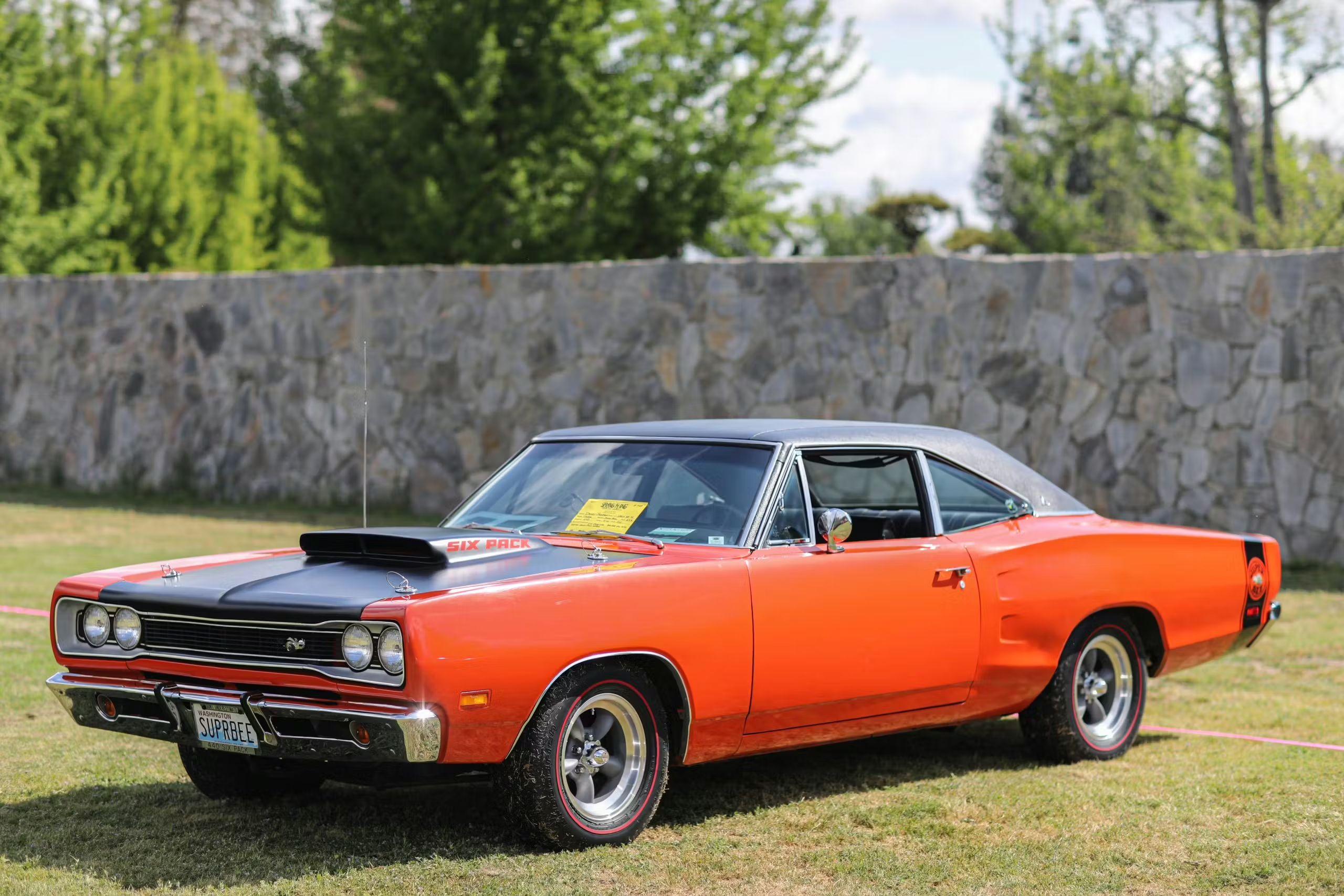
BY BRANDAN GILLOGLY / ORIGINALLY PUBLISHED SEPTEMBER 8, 2025
During the late 1960s and early ’70s, AMC, Chrysler, Ford, and General Motors were trading blows by offering powerful and stylish coupes and convertibles that ranged from understated to downright garish. We tend to favor the latter. Think red, white, and blue AMC Rebels, Carousel Red GTO Judges, and Mopar B-bodies in various eye-searing High Impact hues.
AMC had just one brand to offer its muscle, Ford and Mercury represented the corporate Blue Oval, while GM brought Chevrolet, Buick, Oldsmobile, and Pontiac mid-sizers, each with their own beefy V-8 engine families. Chrysler countered with Dodge and Plymouth versions of its mid-size B-body. The Plymouth Satellite spawned the affordable Road Runner as well as the more upscale and luxurious GTX. Dodge took a slightly different route by turning the Coronet into the Super Bee—named after its B-body platform—and also created the sleek Charger, which was available only as a coupe. The two-pronged attack from both Dodge and Plymouth helped Mopar offer muscle cars at various prices and counter GM’s four-brand strategy.

Like the other mid-size Mopar B-bodies, the Coronet underwent a major redesign for 1968, introducing shapelier sheetmetal compared to its more faceted predecessor but using identical wheelbases: 116 inches for sedans and coupes, 117 inches for wagons. As with all Mopars, the 1968s can be identified by their small, circular marker lights on the fenders and quarter panels. The 1968 Coronets also use unique taillights, with tripartite trapezoidal lenses. Available powertrains included a 145hp Slant-Six, two small-block V-8s at 273 and 318 cubic inches, two 383 big-blocks in 290hp two-barrel and 330hp four-barrel guise, a 375hp 440, and the 425hp 426 Hemi. The Super Bee was available with a 335hp Magnum version of the 383, with cylinder heads swiped from the 440 Magnum.

For 1969, Coronets got rectangular marker lights to match the rest of the Mopar lineup, as well as more rectangular taillights and a new grille with thicker headlight bezels. In the rear, upper trims like the 500 and R/T added a third taillight in the middle to span almost the entire tail panel, cribbing a bit from the Charger’s wide twin-taillight look. Dodge dropped the 273 V-8 in 1969, leaving the 318 as the sole small-block V-8 in the Coronet. The V-8 deletion was more than made up for with the addition of the 440 Six Pack, which used three two-barrel Holley carbs to increase airflow and bridge the gap to the Hemi. Output for the 440 Six Pack was 390 hp.

The 1970 model saw the biggest aesthetic changes, with a split grille ringed in chrome. The tail panel on most Coronets looked like an evolution of the 1968 model, this time with three trapezoidal elements split by twin backup lights on each side. Super Bees and Deluxe trims got a tail panel with rectangular lights divided by a horizontal chrome strip. Powertrains carried over from the 1969 model year. A Torqueflite three-speed automatic transmission was standard on R/T models, and an option with all other powertrains. The four-speed manual was a no-cost option for the R/T and available on all of the four-barrel V-8s.
It’s no secret that 1968–70 Chargers have long been a favorite among muscle car collectors, but they’ve seen a recent drop in values. Meanwhile, the median #2 (excellent) value of 1968–70 Coronets of all varieties is up 20% over the last five years and 26% over the last 10 years. There’s still quite a gulf in value between the Charger and Coronet despite their mechanical similarities. Comparing R/T models of the Charger and Coronet equipped with identical 440-cubic-inch, four-barrel V-8s, the Charger is worth about 50% more, with #2 (Excellent) examples of the Charger going for $90,700, while a similar Coronet will bring $62,200. The gulf widens when talking about 426 Hemi variants, where even the Super Bee lags. A 1970 Super Bee in #2 (Excellent) condition is worth $94,000, while a Charger with the same Elephant engine is worth $180,000. One of the few examples of a Coronet getting close to Charger values is when comparing a 1969 Charger R/T to a Coronet R/T convertible. In that case, the 440-powered hardtop still carries a 7% premium over its Coronet convertible counterpart.

The Coke-bottle styling of the 1968–70 Charger made it one of the most beloved designs of the muscle car era. A 1968 Charger served as the hubcap-shedding foil for Steve McQueen’s Bullitt in one of the most storied car chases in cinema history and also as one of the most recognizable recurring car stars in the Fast and the Furious franchise. For many buyers, the only thing wrong with a Coronet is that it’s not the iconic Charger. However, with its own stunning looks, a variety of Mopar V-8 powerplants, and the availability of a convertible model, collectors are seeing the value in the Coronet, particularly the R/T and Super Bee, with prices rising to match demand.
For now, it seems that mostly older collectors are the ones who appreciate Coronets the most, with baby boomer and Gen X buyers making up more than 80% of the market, leaving millennial and Gen Z buyers with 17%. Charger demographics seem similar at first glance, although millennials and Gen Z make up 22% of that market, which represents a significant shift. Whether or not younger buyers embrace the Coronet will determine if this trend of rising Coronet values continues.
This article has been reproduced with the permission of the copyright holder, Hagerty. Further reproduction is prohibited without permission. Click here for more automotive tips and stories, or here for more information on the next Pomona Swap Meet & Classic Car Show.
Related Posts
100 Years of Chrysler: The Original Recipe and the Early Days
June 10, 2025

The History of Rumble Seats
February 17, 2025

Time Travel to a ’60s Dragstrip on Your Lunch Break
November 27, 2024

